From all of us at the Victorian Society of Alberta to all of you, wishing you a very Merry Christmas!

From all of us at the Victorian Society of Alberta to all of you, wishing you a very Merry Christmas!
This is the menu for the Christmas day meals served to Canadian troops in England in 1918.

Note that their supper was largely served cold. This would have given the cooks an easier afternoon, with just the blancmange to cook and the pies to bake.
The Victorian Society of Alberta.
Yesterday, December 14 2024, we had our annual ramble at Heritage Park's "Once Upon a Christmas".

The weather was just around freezing with snow still on the ground from a recent snowfall here in Calgary. There was a lot of ice on the roads but the board walks were clear and the park did a great job of keeping the roads sanded.
This year was the largest group participation in this event, with VSA members, WWI re-enactors and a couple of Civil War re-enactors rounding out the group.
 |
| VSA members and Guests on the Porch of the Prince House |
 |
| The Prince House |
 |
| Heading into town |

 |
| Meeting with the Town Crier |

 |
| Junior Telegraphers Keeping up a steady traffic to the North Pole. |
 |
| Junior Telegrapher Bravely manning the North Pole station (in the back room) |
 |
| Marilyn (L) and Janice (R) Marshalling the lineup and writing out the telegrams for the kids. |
 |
| On the road to the "Settlement" |
 |
| Laggan station, closed for the winter, was the original station from Lake Louise. |


 |
| Stunning light displays in the park |

Another great Christmas Ramble.
Looking forward to next year.
Wishing you all a very pleasant Christmas Season.
The Victorian Society of Alberta
This month a fascinating video from Nicole Rudolph on YouTube.
Travel clothes
Enjoy
The Victorian Society of Alberta
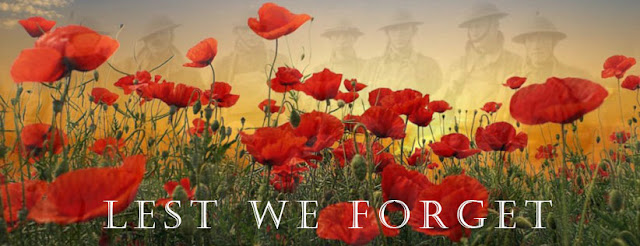
Remembrance Day was first observed in 1919 throughout the British Commonwealth. It was originally called “Armistice Day” to commemorate armistice agreement that ended the First World War on Monday, November 11, 1918, at 11 a.m.—on the eleventh hour of the eleventh day of the eleventh month.
From 1921 to 1930, Armistice Day was held on the Monday of the week in which November 11 fell. In 1931, Alan Neill, Member of Parliament for Comox–Alberni, introduced a bill to observe Armistice Day only on November 11. Passed by the House of Commons, the bill also changed the name to “Remembrance Day”. The first Remembrance Day was observed on November 11, 1931.
Every year on November 11, Canadians pause in a moment of silence to honour and remember the men and women who have served, and continue to serve Canada during times of war, conflict and peace. We remember the more than 2,300,000 Canadians who have served throughout our nation’s history and the more than 118,000 who made the ultimate sacrifice.
by Kevin Jepson
When I was growing up history was something that permeated our house.
There were books and photos, and old records.
There were fossils, models, maps and artifacts.
I was always interested in military history, because the military and warfare runs like a horrible bloody thread through the history of civilization. Didn't matter if it was ancient history, Romans, Greeks, Persians, Celts, or Medieval sieges and battles, or 18th and 19th C wars, or the great upheavals of the 20th C. I was interested in them all. There was one thing that I remember very clearly though and that was the major difference in the way my Father treated the wars of the 20th C compared to those of history.
These wars were different, they were different because they were still MEMORY not just HISTORY. My Grandfather fought in the First World War and I had friends whose parents had fought in the Second.
The Ghosts of these wars were not ready to be history yet. They were real people still living, still working, still hugging their loved ones and trying to live with the MEMORY of chaos and destruction that they had been forced to live through. They also struggled with the memory of those they had lost.
.jpg) |
This fascinating video shows how Sourdough was made in the mid 1800's.
Enjoy
The Victorian Society of Alberta

